

Case study: Solar farm repowering.
Ethical Power delivers repowering services by replacing outdated assets with advanced, high-performance technology to fully restore your site’s peak performance capabilities.
In recent years, we repowered a 1.8MW renewable asset in the UK, owned by one of our loyal customers, and it was commissioned in 2015. Ethical Power was selected as the principal contractor to deliver the full-wrap EPC (Engineering, Procurement and Construction) services, as well as O&M (Operations and Maintenance) services once the park was energised.
The site spans 2 hectares and comprises of over 4500 modules.
After almost 10 years of generating, the site received a repower in 2024, managed by the Ethical Power O&M team.
A new beginning.
Solar farms’ workloads are usually heavy and constant, which is why components degrade over time. When this happens, the performance of the asset decreases and doesn’t meet the standard required.
Over the years, both ourselves and the client became aware that the components on site were starting to degrade. This sparked the conversation about a possible repower in May 2023. Our client was pleased about the thought of a repower on their solar farm, so we got to work.
Before on-site works commenced, our team worked hard researching and sourcing the best parts on the market for optimal generation once re-energised. To get the client’s renewable asset back to peak performance, we proposed what work could be carried out on the site, what we believed was needed, and what could be done within the client’s budget.
We finalised the proposal, and all that was left to do was get started, and so in January 2024, we began bringing the renewable asset back to life!
Because of new and advanced technologies, we had more options when it came to replacing the site components.
In this case, new technology allowed us to install 11 Huawei 100KTL inverters, replacing the 66 that were on site, and improving the peak performance.
Other works included the installation of main AC feeds to the inverters and the replacement of the combiner boxes with uprated switch disconnectors and AC fault protection. The DC cable was also extended into the new inverter positions and housed in newly installed galvanised cable baskets.
When the site was re-energised, all the necessary intrusive planned preventative maintenance (PPMs) were carried out as per the schedule of the asset.
Now it was time to wait and see the results of this repowering.
Case study: Revamping.
Revamping a renewable energy asset focuses on returning singular underperforming or broken components to their initial capacity by replacing them with a like–for-like or upgraded component. This would help prolong component warranties and address any performance issues.
The revamp begins.
In 2024, we became aware of a transformer with an internal issue on one of our clients’ assets. This was picked up through multiple oil samples and diagnostic testing. As a precautionary measure, exclusion zones were established, and works were planned to ensure all investigations could be undertaken safely and in line with high-voltage operational standards.
Despite extensive testing, the root cause of the issue could not be conclusively identified at that stage. Following an oil replacement and further validation checks, the transformer was returned to service. Approximately two months later, the transformer experienced a catastrophic internal failure and required full replacement.
At the time, industry-wide supply chain constraints meant that procuring a new like-for-like transformer carried a lead time measured in many months. Extended outages of this nature can have a significant impact on asset availability and revenue. To mitigate this risk, Ethical Power worked closely with the client and their preferred contractor to implement a staged replacement strategy.
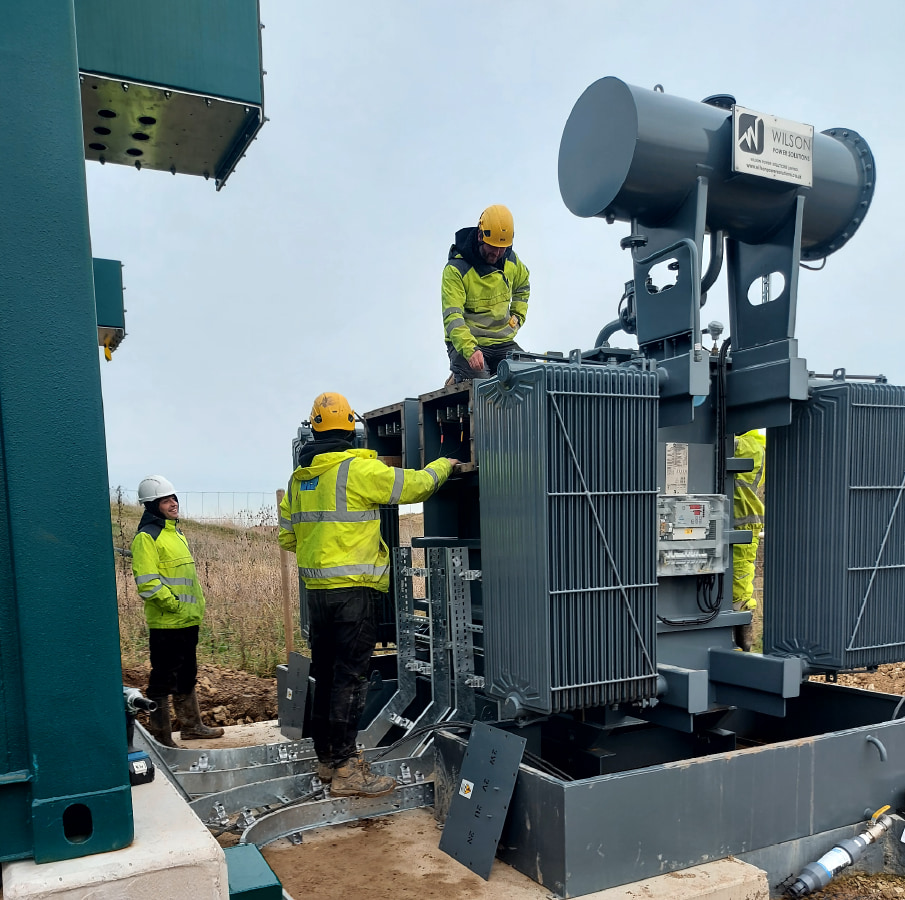
A suitable temporary transformer was sourced and installed, allowing the asset to remain operational while the permanent replacement transformer was ordered and manufactured. To facilitate the installation, a temporary access road was constructed to enable safe crane access and positioning.
Ongoing monitoring during operation indicated that the temporary solution would not provide the long-term operational stability required for the site. To maintain availability and manage risk, a second temporary transformer was procured and installed, ensuring continued generation while the permanent solution progressed.
As part of the wider revamp works, the team also made the decision to upgrade the transformer housing from a Type 1 enclosed unit to a Type 2 standalone configuration. This required bespoke site reconfiguration and cable routing works, all of which were completed in advance of transformer delivery to minimise disruption. These changes were carefully planned and executed to ensure compatibility with the site’s existing infrastructure and future operational requirements.
Throughout the works, only one-third of the site experienced any performance loss at a given time, an exceptionally low impact for a project of this complexity involving multiple transformer interventions. This was achieved through detailed planning, close coordination between site and control room teams, and a consistent focus on reducing downtime wherever possible.
This project demonstrates that even relatively young assets, in this case approximately 10 years old, can experience significant technical challenges. Without a proactive approach, deep high-voltage expertise, and strong collaboration between client, contractor, and Ethical Power’s in-house teams, these issues could have resulted in substantial and prolonged performance losses.
Instead, through adaptive engineering, informed decision-making, and a clear focus on asset availability, the site continued to operate effectively while a long-lead critical component was safely and successfully replaced.